Captain Thomas Mantell’s UFO Pursuit: What the 1948 Records Show
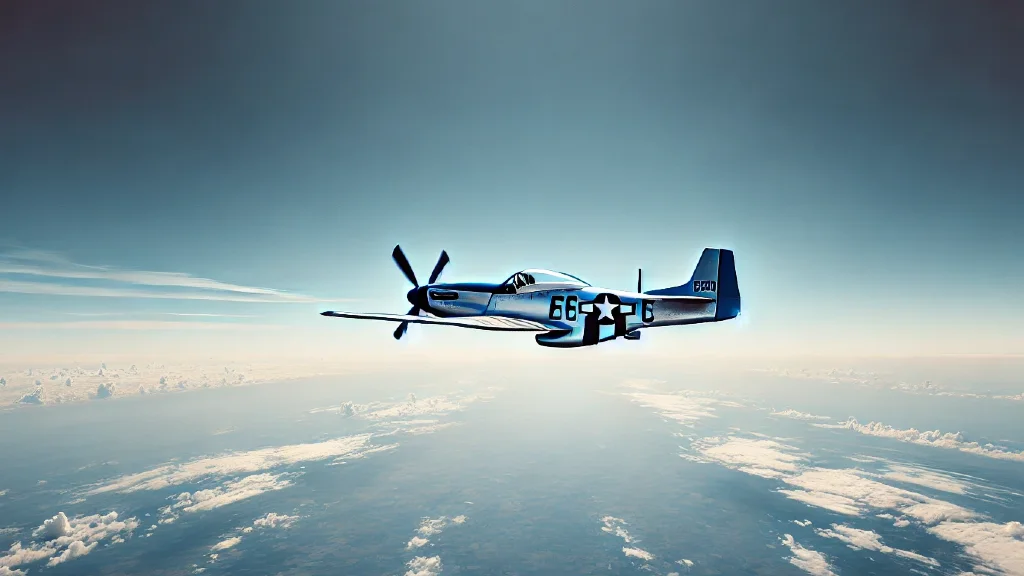
Three Mustang pilots turned toward an unidentified object over Kentucky on January 7, 1948. Two broke off the climb; Captain Thomas Mantell kept going.
He was 25, a decorated wartime pilot, and flying without oxygen equipment. What began as a request to take a closer look ended with his aircraft breaking apart and a UFO story that outlived him.
The accident investigation points to oxygen deprivation followed by loss of control. The object itself is harder to account for, although a high-altitude research balloon offers a plausible explanation.
To understand how those two parts of the story became tangled, start with the flight Mantell was supposed to finish.
Four Mustangs Heading Home
Mantell and three other pilots were returning to Louisville from Marietta, Georgia. They had gone to retrieve aircraft left behind because of bad weather, according to operations officer Richard Tyler’s January 12 report.
Their flight leader had already served in World War II troop-carrier operations and earned the Distinguished Flying Cross. Back in Kentucky, Thomas Francis Mantell Jr. had joined the Air National Guard’s 165th Fighter Squadron, as the Guard’s history records.
Near Fort Knox, their journey intersected with a problem on the ground. Personnel at Godman Army Airfield could see an object in the sky, but couldn't identify it.
Tower operator Quinton Blackwell later recalled asking Mantell whether he had enough fuel to investigate. Mantell agreed, taking two pilots with him while the fourth continued toward Louisville.
The request sounded straightforward: fly closer and have a look. But getting closer would require a climb, and the three pilots weren't equally equipped for it.
A Bright Object, but No Clear Identification
During the pursuit, Mantell reportedly described something metallic and of “tremendous size.” Those words helped give the encounter its lasting image: a fighter approaching an enormous, unfamiliar craft.
They come from Blackwell’s January 15 statement, which also mentions reflected sunlight. Blackwell was recalling an unrecorded conversation, and he warned that his times were approximate.
The other airborne account is less dramatic. In his January 9 statement, fellow pilot Clements described a small, bright object too distant for him to determine its size, shape, or color.
That leaves a basic problem with the image of a giant craft: nobody had established how far away it was. Without distance, apparent size can be deceptive, whether you're looking from a control tower or a fighter cockpit.
The pilots still needed a better view. As they climbed to get one, the oxygen problem became urgent.
Two Pilots Turn Back
Clements reported putting on his oxygen mask at about 16,000 feet. Mantell and Lieutenant Hammond lacked oxygen equipment, according to Clements’s statement.
Higher up, Hammond signaled that he was having difficulty. Clements said he broke away with him at roughly 22,500 feet, while Mantell continued upward.
This is the turning point in the flight. Two pilots were descending, and the remaining pilot was still climbing without the equipment that altitude demanded.
As air pressure falls, each breath supplies less oxygen to the body. The resulting shortage in body tissues is called hypoxia, and it can damage the very judgment a pilot needs to recognize the danger, as the Federal Aviation Administration explains.
Coordination, memory, and alertness can deteriorate. A misleading sense of well-being can accompany those losses, so feeling capable is no guarantee of being capable.
Mantell’s wartime experience offered no immunity. We cannot know what he was thinking as he continued, or exactly when he became incapacitated.
To reconstruct what happened next, investigators had to turn from radio reports to witnesses on the ground and the wreckage of his Mustang.
The Crash Had a Physical Explanation
Major Robert J. D. Johnson’s special investigation report traced the accident to oxygen deprivation. He concluded that Mantell lost consciousness, the aircraft entered a spiral and powered dive, and excessive speed caused it to break apart.
The report records witnesses seeing the descent and breakup without observing a fire in the air. It also places Mantell’s body in the cockpit, contradicting later stories that his body had disappeared.
Nobody witnessed the final moments from inside the aircraft, so the sequence remains a reconstruction. But it ties together the climb without oxygen equipment, the descent witnesses described, and the damaged aircraft.
Nothing in that sequence requires an attack by the object. The fact that a pilot died during a pursuit does not establish that the target brought him down.
That gives the crash a supported explanation while leaving the question that started the flight: what had the tower and pilots been watching?
Venus Seemed to Offer an Answer
Venus became an early candidate because its position was broadly compatible with the reported direction. A familiar planet could explain an unfamiliar light, provided it was visible under the conditions that afternoon.
That qualification became a sticking point. In his 1956 account, Air Force investigator Edward Ruppelt recalled consulting astronomy adviser J. Allen Hynek, who doubted that Venus was sufficiently visible in the circumstances.
Ruppelt also questioned whether a point of light could account for the shapes witnesses described. Direction alone wasn't enough to settle the identification.

- Read J. Allen Hynek's assessment of the UFO reports he investigated
- Explore the cases and disputes behind Project Blue Book
- Add historical context when comparing modern UAP claims with earlier investigations
The Air Force’s explanations would face more scrutiny in later cases, including the separate 1952 Washington, D.C., sightings.
For Mantell’s pursuit, another candidate offered something Venus couldn't: a large physical object capable of floating far above the fighters.
A Balloon the Fighters Might Never Reach
Skyhook research balloons carried scientific instruments high into the atmosphere. The first flew in September 1947 and reached about 30 kilometers, or 98,000 feet, according to a Smithsonian history.
That is more than four times the altitude at which Clements said he turned back. A fighter could gain thousands of feet and still be nowhere near such a balloon.
Ruppelt examined witness descriptions, regional balloon observations, and winds that could support a route from Ohio. A balloon offered a workable explanation, but his investigation lacked a crucial record: confirmation of a January 7 launch from Clinton County, the proposed starting point.
There was, however, a nearby sighting in which someone got the better view the pilots had been seeking.
Through a Telescope, the Mystery Changed
Vanderbilt astronomer Carl Seyfert examined a bright object near Nashville on the afternoon of the pursuit. As The Nashville Tennessean reported the next day, he had considered Venus and a comet.
Through a telescope, he could distinguish a balloon’s shape and a hanging rope with small objects attached. What had looked puzzling at a distance acquired recognizable details.
That observation strengthens the case for a balloon in the region. It does not prove that Seyfert and Mantell were watching the same one.
Connecting them would require more than a similar appearance on the same afternoon. A launch record, winds, and the witnesses’ locations and viewing directions would need to place the balloon where each person reported seeing it.
For readers who watch the sky themselves, Seyfert’s experience offers a useful habit: record what you can actually distinguish before deciding what it is. Time, location, direction, and visible features give someone else a chance to check your interpretation.

- Learn your way around the night sky with a guide built for observers
- Choose worthwhile sights for evenings outside
- Develop observing skills you can use with binoculars or a telescope
Other cases offer different material to examine, such as the photographs associated with the 1951 Lubbock Lights.
What Remains Unanswered
The gap in the balloon explanation is specific: the records discussed here do not securely match a particular flight to Mantell’s target. Filling that gap would help identify the object; it would not erase the evidence of a climb without oxygen.
Readers who want to follow the paper trail can start with the National Archives’ guide to Project Blue Book. The linked witness statements are especially useful alongside later accounts, because details can change as a story is retold.
The broader discussion of what UFO evidence can establish continues in this overview.
Mantell set out to get a better look at something the people below couldn't explain. The surviving accounts suggest that he kept climbing into a danger that could take away his ability to turn back.
A balloon remains a plausible answer to what drew him upward. Understanding why he never returned does not depend on proving that identification.
Nimitz Tic Tac UFO Encounter: The UAP Case That Changed Everything

Roswell UFO Incident: Crash, Cover-Up, and Alien Legend